Introduction
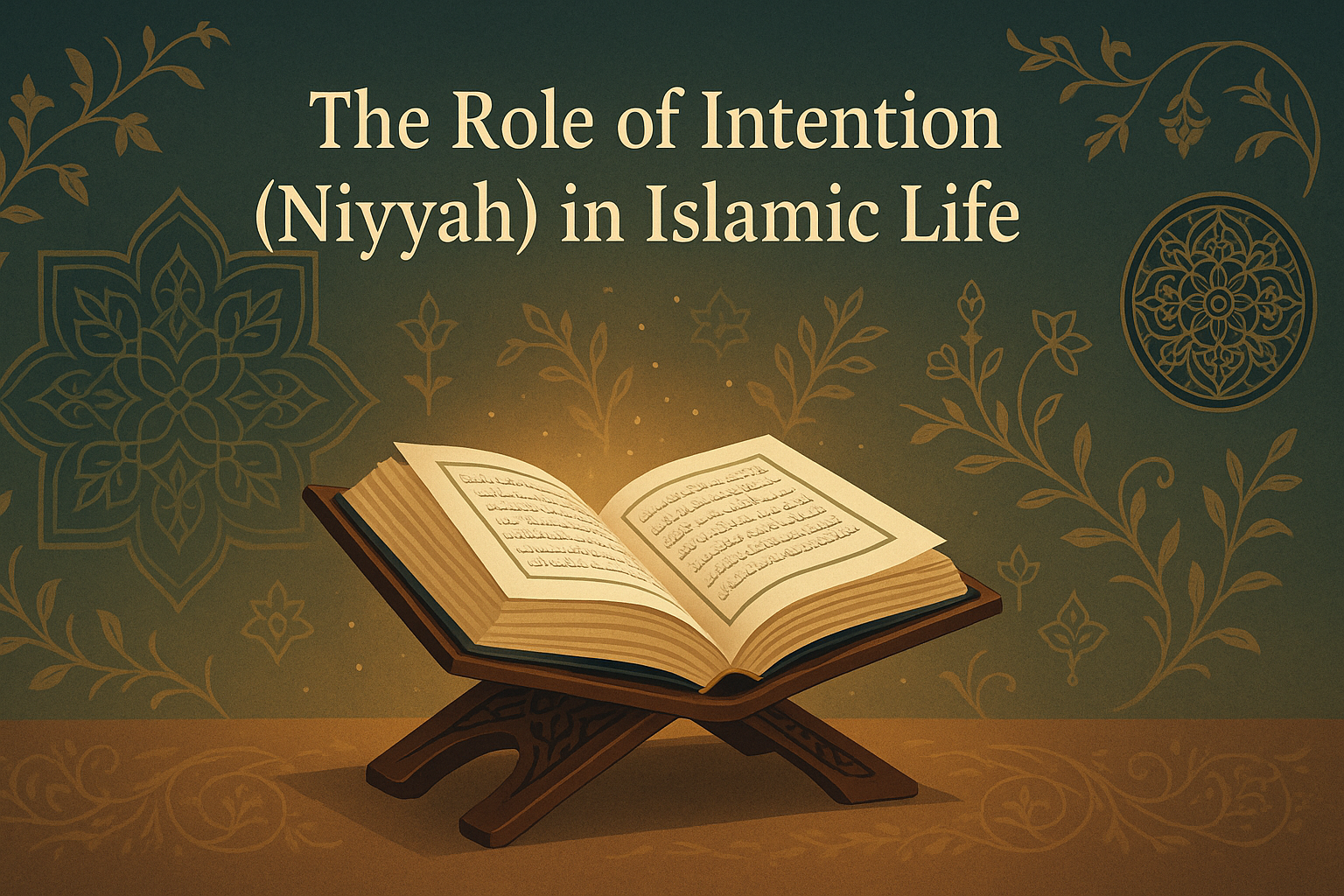
In Islam, outward actions matter — but what lies in the heart matters even more. The concept of niyyah (intention) is one of the most profound spiritual principles in the Quran and Sunnah. It transforms ordinary actions into acts of worship and gives meaning to rituals, charity, relationships, and daily work. Without sincere intention, even good deeds lose their value; with sincere intention, even simple acts become spiritually rewarding.
In an era of digital performance, social pressure, and constant visibility, the Quranic emphasis on intention offers Muslims a path to sincerity, inner clarity, and spiritual discipline. Understanding niyyah is essential for anyone seeking to live an authentic Islamic life.
1. The Essence of Niyyah in Islam
The foundation of niyyah comes from one of the most famous hadiths:
“Actions are only by intentions, and each person will have only what they intended.”
(Sahih Bukhari & Muslim)
This hadith shows that the value of an action is directly tied to the intention behind it. Two people may perform the same deed — praying, giving charity, reading Quran — but one gains immense reward while the other gains nothing, depending on their sincerity.
Niyyah is the invisible soul behind visible actions.
The Quran affirms that Allah looks beyond outward forms:
“Allah does not look at your forms or your wealth, but He looks at your hearts and deeds.”
(Based on hadith; supported by Quranic themes)
Islam is not a religion of empty ritual — it is a faith centered on internal purpose.
2. Quranic Foundations of Sincere Intention
The Quran repeatedly emphasizes sincerity (ikhlas) as a central condition for faith and worship.
A. Worship must be solely for Allah
“And they were commanded only to worship Allah, being sincere to Him in religion.”
(Surah Al-Bayyinah 98:5)
This verse establishes that intention is the foundation of all worship.
B. Hidden motives corrupt good deeds
“Whoever desires the reward of this world — We give him thereof; but he has no share in the Hereafter.”
(Surah Ash-Shura 42:20)
Good deeds done for worldly praise or status lose their spiritual reward.
C. Allah knows what the heart conceals
“Indeed, He knows the secrets of the hearts.”
(Surah At-Taghabun 64:4)
Nothing is hidden from Allah — not even the slightest intention.
3. Types of Intentions in Islam
A. Intention for Worship (Ibadah)
Every act of worship — prayer, fasting, zakat, Hajj — requires intention.
Without niyyah, these acts become empty rituals.
B. Intention for Worldly Activities
Islam uniquely allows daily tasks to become acts of worship when done with the right intention.
Examples:
- Sleeping with the intention of restoring strength to worship
- Eating to maintain health
- Working to provide halal income
- Studying to benefit others
- Raising children as an amanah
C. Intention for Good Habits
Even smiling, removing harm from a path, or helping a neighbor — when done for Allah — become rewarded actions.
D. Intention for Abstaining from Sin
If a person resists a temptation solely for Allah, that act becomes an act of worship.
4. Niyyah as a Shield Against Showing Off (Riya’)
One of the greatest spiritual dangers is performing good deeds to be seen by others. The Quran warns:
“Woe to those who pray but are heedless of their prayer — those who make a show of their deeds.”
(Surah Al-Ma’un 107:4–6)
Riya’ destroys sincerity and turns worship into performance.
How niyyah combats riya’:
- It reminds the believer of whom they truly serve
- It purifies the heart from ego
- It transforms worship from mechanical to meaningful
- It prevents the desire for praise or recognition
Niyyah is the unseen force that protects the soul from spiritual corruption.
5. Niyyah in Charity and Good Deeds
Charity is one of the easiest actions to get mixed intentions. Allah warns against giving for show:
“Do not nullify your charity with reminders or hurtful words, like those who give to be seen by people.”
(Surah Al-Baqarah 2:264)
On the other hand, hidden charity is praised:
“If you give charity openly, it is good; but if you give it secretly, it is better for you.”
(Surah Al-Baqarah 2:271)
Intention determines whether charity becomes a blessing or a wasted opportunity.
6. Renewing Intention: A Continuous Process
Niyyah is not a one-time declaration. It is a living state of the heart.
Ways to renew intention:
- Pause before every action
- Remind yourself of Allah’s presence
- Ask: “Why am I doing this?”
- Refresh intention during the action
- Seek forgiveness if your motives shift
Even scholars say:
“A believer checks his intention more often than he checks his deeds.”
Because the heart changes quickly, and sincerity must be maintained.
7. The Transformative Power of Niyyah in Daily Life
With sincere intention, an ordinary life becomes extraordinary.
A. Work becomes worship
A job done to earn halal income or support one’s family becomes spiritually rewarded.
B. Marriage becomes worship
Showing kindness, patience, and support becomes a pathway to paradise.
C. Parenting becomes worship
Teaching children Qur’an and values becomes ongoing charity (sadaqah jariyah).
D. Community service becomes worship
Any act done for human welfare becomes an act beloved to Allah.
8. Niyyah and Personal Growth in the 21st Century
In a world that values image over essence, niyyah provides:
- Emotional grounding
- Authenticity
- Meaningful purpose
- Purification from ego
- Protection from comparison and competition
- A way to stay centered in a distracted age
The concept of niyyah is more relevant now than ever.
Recommended Books from The Quran Foundation Library
- Purification of the Heart: Understanding Niyyah and Ikhlas – by The Quran Foundation
📘 Free PDF: https://thequranforfree.com/ebooks
📗 Amazon Hardcopy: https://www.amazon.com/s?k=The+Quran+Foundation - Tafseer al-Quran: Verses on Sincerity and Intention – Urdu & English
📘 Free PDF: https://thequranforfree.com/ebooks
📗 Amazon: https://www.amazon.com/s?k=Tafseer+al-Quran
Conclusion: The Heart of Worship
Niyyah is the spiritual engine that powers every action. It defines the difference between habit and worship, between routine and righteousness, between empty deeds and transformative faith.
When the heart is sincere, the smallest deed becomes massive in Allah’s sight. When intention is corrupted, even large deeds become empty.
To live an Islamic life in the modern world, one must start from within — with niyyah.
➡️ Explore more free Tafseer books and Quranic studies:
https://thequranforfree.com/ebooks