Introduction
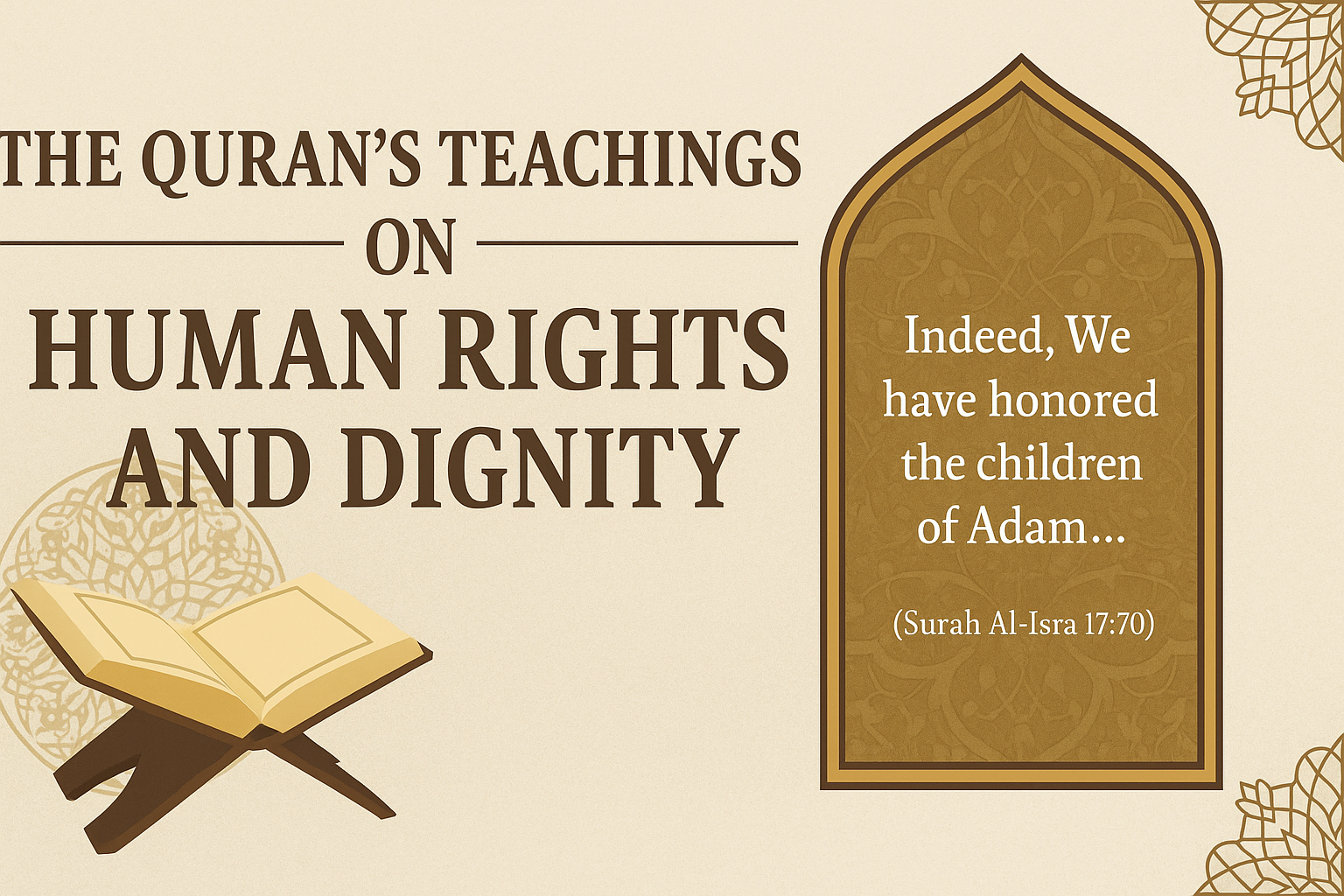
Human rights and dignity are often portrayed as modern concepts born out of recent political movements. However, the Quran established a comprehensive framework of human dignity, equality, justice, and rights over fourteen centuries ago. Long before international charters and declarations, the Quran affirmed the sanctity of human life, honor, freedom, and moral worth — not based on race, gender, wealth, or power, but on humanity itself.
The Quran presents human rights not as optional ideals, but as divine obligations. These rights are deeply rooted in faith, accountability, and moral responsibility. They apply to individuals, families, communities, and states alike.
This article explores the Quran’s teachings on human rights and dignity and highlights their timeless relevance in today’s world.
1. Human Dignity: A Divine Gift From Allah
The Quran establishes human dignity as an inherent honor granted by Allah:
“Indeed, We have honored the children of Adam…”
(Surah Al-Isra 17:70)
Key implications:
- Human dignity is universal
- It applies to all people, regardless of belief, race, or status
- It is not earned — it is granted by Allah
This verse forms the foundation of Islamic human rights. Every human being carries intrinsic worth.
2. Equality of All Humans
The Quran rejects all forms of racial, tribal, and social superiority:
“O mankind, We created you from a male and a female and made you nations and tribes so that you may know one another. Indeed, the most honored of you in the sight of Allah is the most righteous of you.”
(Surah Al-Hujurat 49:13)
Key lessons:
- No race or ethnicity is superior
- Social status does not define worth
- Moral character (taqwa) is the true measure
This Quranic principle dismantles racism, nationalism, and classism at their roots.
3. The Sanctity of Human Life
One of the strongest human rights in the Quran is the protection of life:
“Whoever kills a soul unjustly — it is as if he has killed all of mankind.”
(Surah Al-Ma’idah 5:32)
And conversely:
“Whoever saves a life — it is as if he has saved all of mankind.”
(5:32)
Lessons:
- Human life is sacred
- Murder is among the gravest crimes
- Preserving life is a noble act
This principle underpins Islamic teachings on justice, warfare, punishment, and social responsibility.
4. Justice as a Fundamental Human Right
Justice is central to human dignity in Islam:
“Indeed, Allah commands justice and excellence…”
(Surah An-Nahl 16:90)
And:
“Stand firmly for justice, even against yourselves, your parents, or relatives.”
(Surah An-Nisa 4:135)
Key principles:
- Justice applies to everyone
- Personal bias must not influence fairness
- Justice is a moral and legal obligation
Without justice, human rights lose meaning.
5. Protection of Honor, Reputation, and Privacy
The Quran protects personal dignity by forbidding behaviors that humiliate or degrade others:
“Do not mock one another…”
“Do not insult one another…”
“Do not spy…”
“Do not backbite…”
(Surah Al-Hujurat 49:11–12)
These verses protect:
- emotional well-being
- personal reputation
- social harmony
- psychological dignity
Islam recognizes that dignity is harmed not only physically, but also emotionally and socially.
6. Freedom of Belief and Conscience
The Quran firmly establishes freedom of belief:
“There is no compulsion in religion.”
(Surah Al-Baqarah 2:256)
And:
“To you your religion, and to me mine.”
(Surah Al-Kafirun 109:6)
Lessons:
- Faith must be based on conviction, not coercion
- Forced belief contradicts Quranic values
- Human conscience is to be respected
This principle protects religious minorities and personal freedom.
Also Read:
7. Women’s Dignity and Rights in the Quran
The Quran elevated women’s dignity in a society that once buried daughters alive:
“And when the girl buried alive is asked for what sin she was killed…”
(Surah At-Takwir 81:8–9)
The Quran affirms:
- women’s right to life
- ownership of property (4:7)
- financial independence (4:32)
- consent in marriage
- spiritual equality (33:35)
“For men is what they earn, and for women is what they earn.”
(4:32)
Human dignity in Islam applies fully to women.
8. Economic Rights and Protection From Exploitation
The Quran safeguards economic dignity:
“Do not consume one another’s wealth unjustly.”
(Surah Al-Baqarah 2:188)
It condemns:
- exploitation
- fraud
- usury
- hoarding
Zakat institutionalizes economic justice:
“Zakat is for the poor, the needy…”
(Surah At-Tawbah 9:60)
Economic dignity ensures social stability and human well-being.
9. Rights of the Weak and Vulnerable
The Quran repeatedly commands protection of:
- orphans
- the poor
- travelers
- widows
- the oppressed
“Do not oppress the orphan.”
(93:9)
“And they give food, despite love for it, to the poor, the orphan, and the captive.”
(76:8)
A society’s moral health is measured by how it treats its weakest members.
10. Accountability and Responsibility
Human rights in Islam come with accountability:
“Every soul is responsible for what it has earned.”
(74:38)
This ensures:
- rights are protected
- abuse of freedom is restrained
- justice is upheld
True dignity includes moral responsibility.
11. Human Dignity Even in Conflict
Even during war, the Quran enforces dignity:
“Do not transgress. Indeed, Allah does not love transgressors.”
(2:190)
Islamic ethics prohibit:
- harming civilians
- torture
- destruction without cause
- betrayal
Human dignity is never suspended.
12. Relevance of Quranic Human Rights Today
In today’s world of:
- racism
- inequality
- injustice
- exploitation
- religious intolerance
The Quran offers:
- a universal moral compass
- dignity rooted in divine accountability
- justice balanced with mercy
- rights protected by responsibility
Its vision transcends time and culture.
Recommended Books from The Quran Foundation Library
• Human Rights in the Quran: A Divine Framework for Dignity
📘 Free PDF: https://thequranforfree.com/ebooks
📗 Amazon Hardcopy: https://www.amazon.com/s?k=The+Quran+Foundation
• Tafseer al-Quran: Social Justice, Rights & Human Dignity (Urdu & English)
📘 Free PDF: https://thequranforfree.com/ebooks
📗 Amazon: https://www.amazon.com/s?k=Tafseer+al-Quran
Conclusion: Human Dignity as a Sacred Trust
The Quran establishes human rights not as political slogans, but as divine trusts. It teaches that dignity is:
- inherent
- universal
- protected
- accountable
When societies align with Quranic principles, justice flourishes, oppression declines, and humanity thrives.
➡️ Explore more free Tafseer books and Quranic studies:
https://thequranforfree.com/ebooks